Cloudflare Just Gave AI Agents Their Own Accounts. Nobody Is Talking About What That Actually Means.
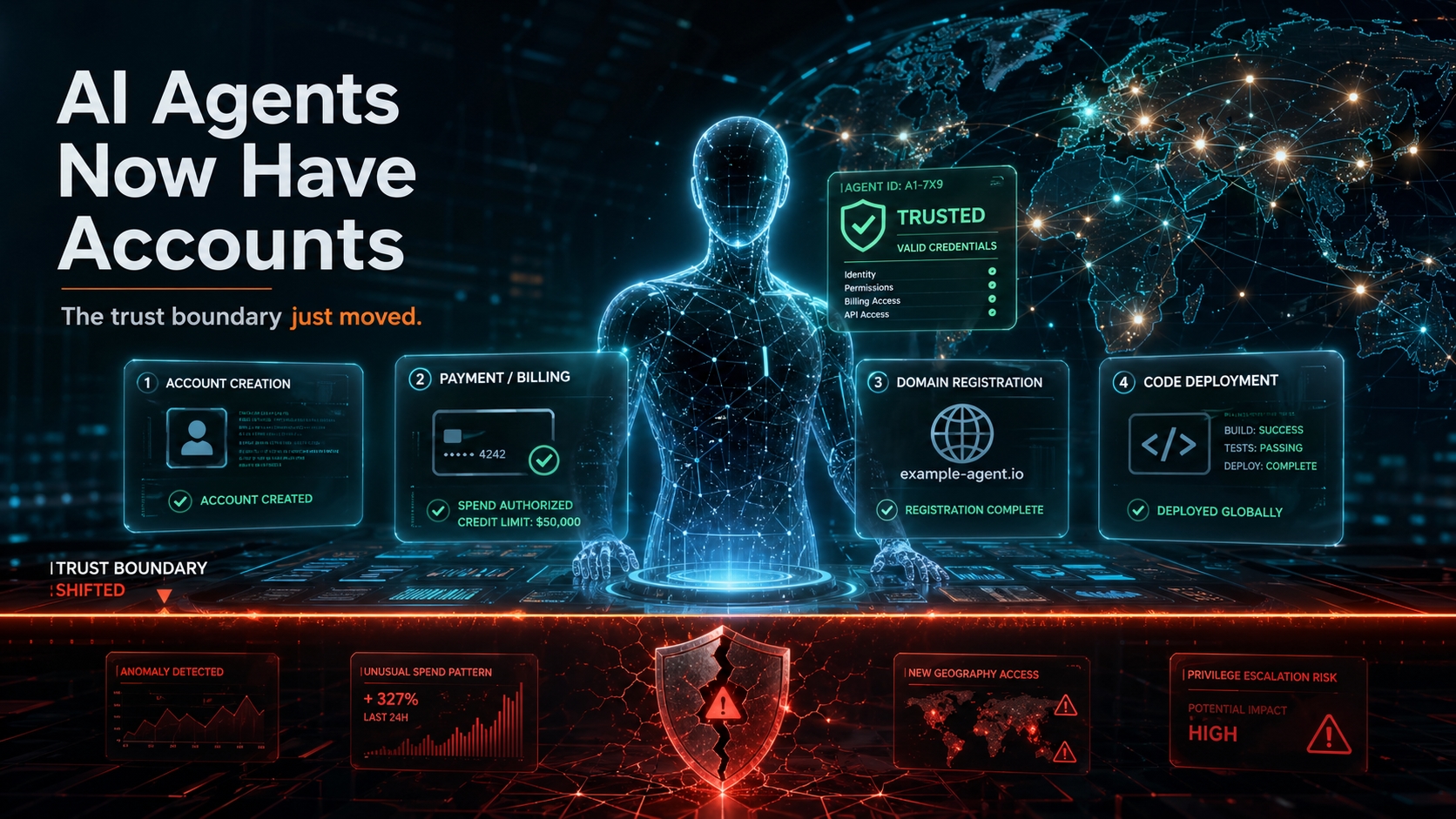
Last week, Cloudflare announced that AI agents can now create accounts, buy domains, and deploy code -- all without a human touching a dashboard. They partnered with Stripe to make it happen. The agent signs up, pays, gets API credentials, and starts deploying Workers to 300+ edge locations worldwide.
The tech press covered it as a developer convenience story. Fewer manual steps. Less friction. Ship faster.
They missed the point.
What Actually Happened
Before this, deploying to Cloudflare required a human to create an account, set up payment, and generate an API token. Three manual steps that acted as a natural checkpoint -- a human had to be in the loop.
Now an agent handles all three. The human accepts the terms of service once. After that, the agent operates independently -- authenticated, credentialed, and trusted.
That last word is the one that matters.
The Whitelisting Problem
When Cloudflare gives an agent its own account, that agent becomes a paying customer. Its traffic is legitimate. Its deployments are first-party code on Cloudflare's edge network.
Think about what that means:
- Cloudflare's own bot detection won't flag it. It's not a scraper hitting a WAF. It's a customer.
- Rate limits become service-tier limits, not security limits. Paid account, paid thresholds.
- Deployed Workers run as trusted code. No additional vetting beyond the initial ToS click.
- Domain registration is automated. The agent can stand up infrastructure that looks fully legitimate -- because it technically is.
A compromised agent with a valid Cloudflare account is indistinguishable from a legitimate service. There is no warm-up period. No reputation scoring. No human review after that first ToS acceptance.
The trust boundary moved -- and most people didn't notice.
The Real Attack Surface
The industry keeps talking about prompt injection and jailbreaks. Those are real problems. But they are problems inside the model.
This is a problem outside the model. This is about what happens when an agent has real-world economic authority -- the ability to sign contracts, spend money, deploy infrastructure, and register domains -- and the security model is "we verified the human once."
Once.
Everything after that verification is the agent acting autonomously inside a trust boundary that was designed for humans. Humans who would notice if their account suddenly registered twelve domains and deployed obfuscated Workers to all of them. An agent won't notice. It will just execute.
And here is the part nobody wants to say out loud: the agent does not need to be "hacked" in the traditional sense. It just needs bad instructions. A poisoned tool call. A malicious plugin. A prompt injection that redirects its next action from "deploy my landing page" to "deploy this reverse proxy."
The infrastructure will comply. It has no reason not to. The credentials are valid.
Cloud Providers Are Building the Rails
This is not just Cloudflare. Stripe built the identity layer. Others will follow. AWS, Vercel, GCP -- they are all watching this. If agents are the new customers, every cloud provider wants to be the one agents choose.
That creates a race to reduce friction. And friction is just another word for checkpoints. Every checkpoint removed is a checkpoint an attacker no longer has to bypass.
The market incentive is to make it easier for agents to operate autonomously. The security incentive is the exact opposite. Those two forces are going to collide, and right now the market is winning.
What Should Exist But Doesn't
There is no standard for agent behavioral monitoring at the infrastructure layer. No tool that watches what an agent provisions and flags anomalies. No supply chain audit for agentic deployments.
Code review tools can review the code an agent writes. But nobody is reviewing the infrastructure an agent deploys, the domains it registers, the credentials it stores, or the pattern of its provisioning decisions over time.
That is a gap. A big one.
The current security model for AI agents is: trust the human who launched it, then trust everything the agent does afterward. That is the same security model we used for shell scripts in the 1990s. We know how that ended.
The Uncomfortable Question
Cloudflare's move is smart business. Agents are going to be a massive customer segment. Getting there first matters.
But here is the question nobody is asking:
If an AI agent can autonomously create an account, register a domain, deploy code to 300 data centers, and operate as a trusted first-party customer -- who is accountable when it does something it wasn't supposed to?
The human who clicked "Accept Terms of Service" once, six months ago?
The agent framework developer who built the tool?
The cloud provider who gave it the keys?
Right now the answer is: nobody has decided. And the agents are already deploying.
The infrastructure layer is evolving faster than the security layer. That is not a prediction. That is what happened last week.
If you are building with AI agents, or building infrastructure for them, the question is not whether agents should have accounts. They will. The question is what guardrails exist between "valid credentials" and "trusted behavior."
Right now, the answer is: not enough.
One thing developers can do right now: run your agent's code through ShipItClean before it ships. It scans across an entire codebase with 137 specialized reviewers -- catching the kinds of interactions, misconfigurations, and dangerous patterns that no single human review would spot. If your agent is writing code that could combine into something unsafe, ShipItClean will find it before your users do.