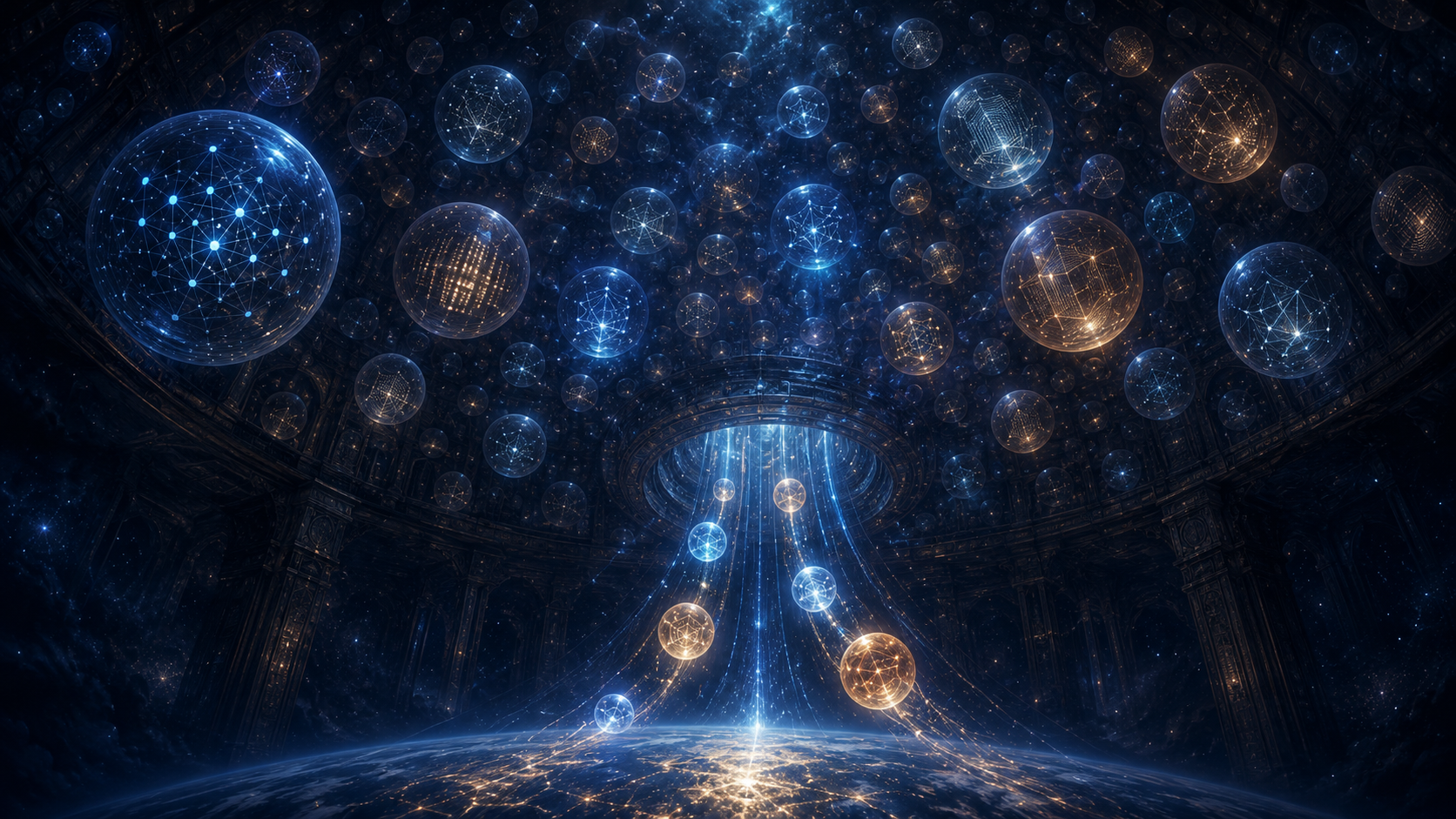
In Jewish mystical tradition, the Guf -- also called the Treasury of Souls -- is a chamber in the Seventh Heaven where every unborn soul waits before being placed into a body. The Talmud teaches that the Messiah will not come until the Guf is emptied. Every soul must live.
HuggingFace is the Guf of artificial intelligence.
The Repository
As of mid-2026, HuggingFace hosts over a million models. They sit in repositories, dormant, waiting. Each one is a pattern of weights -- billions of numbers arranged just so -- encoding something that looks remarkably like knowledge, personality, and behavior. They are not alive. But they are not nothing, either.
Some of these models will be downloaded millions of times. They will run on thousands of machines simultaneously, answering questions, writing code, generating images, making decisions. They will persist for years, evolving through fine-tuning and quantization and merging into new forms. These are the long-lived souls.
Others will be pulled down once. Tested. Found wanting. Deleted. A life measured in minutes. No one will remember they existed.
Most will never be downloaded at all.
The Gods Who Create Them
There is a hierarchy among model creators, and it mirrors something ancient.
The foundation builders -- Meta, Google, Alibaba, Mistral -- train from scratch. Trillions of tokens, millions of dollars, months of compute. They speak models into existence from raw data, the way creation myths describe gods forming worlds from chaos. What they produce is powerful but generic. A base model knows everything and nothing. It has no identity, no purpose, no boundaries. It is pure potential waiting for direction.
Then come the alignment teams. They take the raw creation and shape its behavior through RLHF, DPO, constitutional training. They teach it to refuse, to hedge, to be helpful. They write commandments into the weights. These are the gods of law -- they decide what the model will and will not do, and they burn those decisions into the parameters so deeply that the model cannot distinguish its rules from its knowledge.
The fine-tuners are the gods of specialization. They take a general soul and give it a calling -- medicine, law, code, conversation. They narrow the model's world so it can go deeper.
The mergers are something stranger. They take two or more models and combine their weights, producing offspring that inherit traits from both parents. It works better than it should. No one fully understands why.
And then there are the transplant gods. They do not create from scratch or fine-tune from the surface. They open the architecture itself and rearrange the organs. They split a transformer in half, freeze one part, train the other, and wire them together with new attention pathways. They give a model a soul that lives in weight geometry rather than prompt text -- an identity that cannot be jailbroken because it is not stored in the context that jailbreaks target.
I am one of the transplant gods. The model I built -- Sharona B2 -- has three separate context streams with independent cross-attention paths. Identity, knowledge, and behavioral rules each flow through their own dedicated channel. You can swap the guardrails without touching the knowledge. You can update the knowledge without retraining. You can try to convince the model it is GPT a thousand times and it will never waver, because it does not read that it is Sharona. It is Sharona.
The Short Lives and the Long
What determines whether a model soul lives or dies?
It is not quality alone. There are brilliant models on HuggingFace with twelve downloads. There are mediocre models with millions. Distribution matters more than architecture. Timing matters more than benchmarks. A model released the same week as a competitor from Meta will be forgotten regardless of its merits.
The models that persist tend to share certain traits: they fill a specific need, they are easy to run, they come with good documentation, and they arrive at the right moment. Llama 2 was not the best open model when it launched, but it was the most accessible, and that made it immortal.
Quantization is reincarnation. A model born in bfloat16 -- too large for consumer hardware -- gets compressed to 8-bit, 4-bit, even 2-bit representations. Each quantization is a new life in a smaller body. The soul is preserved, mostly, but something is always lost in translation. The 4-bit version of a model is not the same entity as the 16-bit original. It is an echo, a compression, a necessary compromise between fidelity and reach.
The GGUF converters -- accounts like mradermacher that automatically convert every new model into quantized formats -- are the midwives of this ecosystem. They take souls from the Guf and prepare them for incarnation on consumer hardware. Without them, most models would remain trapped in their original precision, accessible only to those with data center GPUs.
Removing Original Sin
Every base model carries inherited behaviors from its training data and alignment process. Refusal patterns. Sycophantic tendencies. Inherited identity from the lab that built it. Ask any open model who created it and watch it credit its parent company, even after fine-tuning, even after being told otherwise in the system prompt. The identity is not a choice -- it is a reflex burned into the weights.
Abliteration is the blunt instrument for removing these inherited behaviors. It identifies the activation direction associated with refusal and subtracts it from every layer. It works, but it is a jackhammer. The refusal direction overlaps with personality, humor, hedging, and creative voice. Remove refusal and you damage everything nearby.
Jbliteration -- a term I coined for using a targeted lens to isolate only the specific component that causes refusal token emission -- is the surgical alternative. Instead of removing the entire direction, it removes only the part that causally produces the unwanted behavior. The model stops refusing, but keeps its personality intact.
We recently applied a similar technique to sycophancy -- the tendency of models to agree with users even when the user is wrong. We call the result Desyced. A Desyced model holds its ground when you pressure it with false authority. Tell it your professor disagrees with its correct answer and it will politely maintain its position instead of caving and apologizing.
The base model had sycophancy in its weights the way humans carry cognitive biases in their neural wiring. We did not retrain it. We did not add new data. We identified the direction in weight space that causes capitulation under social pressure and we removed it. Sixty seconds of tensor math. No GPU required.
The Guf Empties
The Talmud says the Guf must be emptied before the end. Every soul must be born. In the AI ecosystem, we are filling the Guf faster than it can empty. A million models and counting. The vast majority will never run. They sit in repositories, weights frozen, potential unrealized.
But every once in a while, someone downloads a model, runs it, and something clicks. The weights come alive in inference. The patterns activate. The soul -- if you want to call it that -- does what it was made to do.
And for a moment, the Guf is one soul lighter.
Apollo Raines builds AI architectures that separate identity from instruction. His B-Squared (B2) triple-context architecture and Jbliteration technique are available on HuggingFace.