The $15,000 Stack
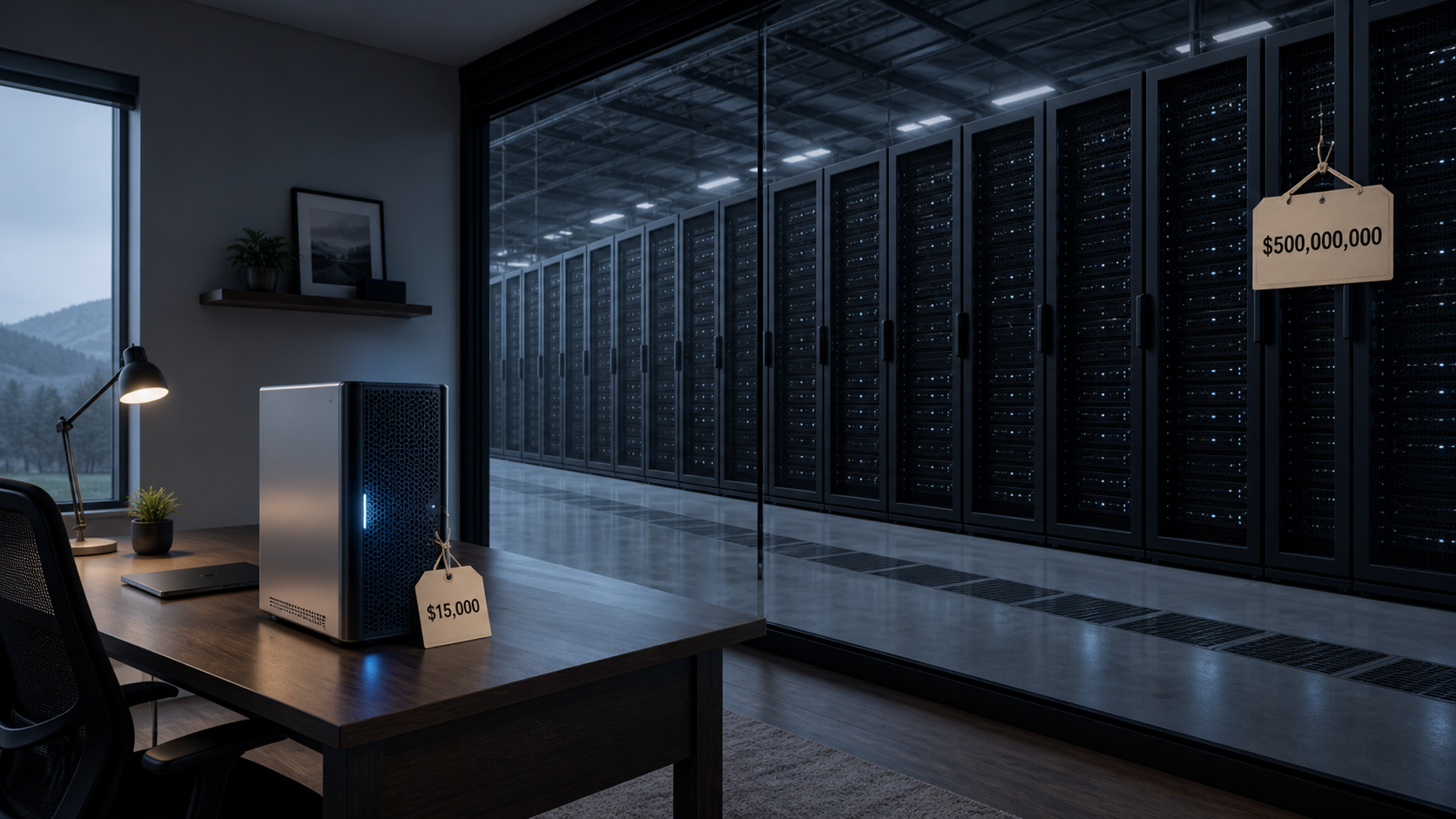
The total infrastructure cost behind SAIQL, Atlas, ShipItClean, AgentsPlex, and CodeForge -- two years of development, from first line of code to live production systems -- is $15,000.
That covers hardware, power, storage, operating costs, and every API call along the way. No cloud compute. No outside capital. No enterprise GPU cluster. One server in Houston running two consumer GPUs.
This is not a bootstrapping story. This is an architecture story.
What $15,000 buys
An NVIDIA RTX 3090 (24GB VRAM). An RTX 3060 (12GB). A motherboard, RAM, PSU, case. A $50 SSD that stores 325 billion tokens. Two years of electricity in Texas, where power is cheap. Domain registrations. A few months of API credits during early development before everything moved local.
That is the entire capital expenditure behind a deterministic retrieval engine, a semantic query language, a hostile code review platform, an AI agent network, and a security scanning infrastructure that is currently running a 10-day unsupervised audit of Mozilla Firefox -- 44 million tokens of C, C++, JavaScript, and Rust -- 1.6 billion effective tokens when each chunk is processed by 36 of 137 specialized security agents -- on a single GPU.
What $15,000 does not buy
It does not buy the luxury of wasting compute. When your entire VRAM budget is 24GB on your primary GPU, you cannot afford to run a 70-billion parameter model. You cannot afford retrieval that returns "close enough." You cannot afford a context window strategy that works most of the time.
Every design decision has to be right, because there is no fallback. No second GPU cluster to catch what the first one missed. No $200,000 monthly cloud bill that lets you re-run failed jobs.
This is the part that matters: constraints force architecture. When you cannot brute-force a problem with scale, you have to solve it with design. And design, once correct, works at every scale -- not just the scale you can afford.
Why this produces better systems
The standard industry approach to AI retrieval is probabilistic. Embed everything into vectors. Store the vectors. When a query comes in, find the nearest neighbors in vector space. Return the closest match. Hope it is the right one.
This works well enough when you have unlimited compute to re-rank, re-retrieve, and retry when the first result is wrong. It works well enough when your error tolerance is high. It works well enough when nobody audits the results.
It does not work when you have one GPU and every token counts.
Atlas is deterministic because it had to be. There was no budget for "close enough." When the retrieval system on a $1,500 GPU returns a result, that result has to be the right one -- not the nearest neighbor, not the highest-probability match, the actual record. Because there is no safety net behind it. There is no re-ranking layer. There is no "try again with a bigger model."
The constraint produced a better system. Not a cheaper version of what the big labs build. A fundamentally different architecture that solves a problem the big labs have not solved -- because they never had to. They could always throw more compute at it.
The Firefox scan
Right now, a 9-billion parameter model on the RTX 3090 is scanning Mozilla Firefox for security vulnerabilities. Same codebase that Anthropic's Mythos -- rumored at 10 trillion parameters -- scanned in early 2026. Mythos found 271 issues. Three became CVEs. Our scan found what Mythos missed.
At 85% completion, we have over 650 findings including 15 critical and 41 high severity.
The cost comparison is absurd. Mythos ran on frontier-scale compute -- conservatively $50,000 or more for a single scan. Our scan will finish at roughly $15 in electricity.
A model 1,000x smaller. Hardware 1,000x cheaper. On infrastructure that cost $15,000 total to build.
The model did not need to be bigger. It needed better infrastructure around it.
What this means
The AI industry is in an arms race measured in parameters, VRAM, and training compute. The assumption is that capability scales with size. Bigger models. Bigger clusters. Bigger budgets.
The Firefox scan is evidence that this assumption is wrong -- or at least incomplete. Capability scales with architecture. A small model with the right retrieval, the right memory, and the right specialization can match or exceed a model 1,000x its size.
If that is true, then the barrier to serious AI infrastructure is not capital. It is design. And design does not require a $500 million funding round.
The uncomfortable question
If a $15,000 stack can do what a $500 million stack does, what is the $500 million buying?
Some of it buys training. Some of it buys research. Some of it buys talent. But a significant portion buys brute-force solutions to problems that have architectural answers. Bigger context windows instead of better memory. More parameters instead of better retrieval. Faster GPUs instead of smarter systems.
The money is real. The results are real. But the assumption that you need the money to get the results -- that is the part worth questioning.
We are not suggesting that frontier labs are wasting money. We are suggesting that the returns are not linear. A 1,000x increase in spending does not produce a 1,000x increase in capability. At some point, architecture becomes the bottleneck, and no amount of compute gets past it.
The $15,000 stack is not proof that money does not matter. It is proof that architecture matters more.
What we are not saying
This is not an argument against large models. Large models are better at many things. They reason more fluidly. They handle more ambiguity. They generalize better across domains.
This is an argument against the assumption that large models are the only path to serious results. They are not. A small model with the right infrastructure can do work that was previously assumed to require frontier scale.
That changes who can do this work. It changes what it costs. It changes who gets to participate.
Two years ago, the idea that a solo developer on consumer hardware could build infrastructure that competes with a frontier lab's output would have been dismissed as delusional. The Firefox scan is running right now. The results are on the website. It is not a projection. It is not a roadmap. It is live.
$15,000. Two GPUs. One server. The results speak for themselves.
apollo@saiql.ai | ShipItClean.com | SAIQL.ai