Three AIs Said Never Release This.
The AI Safety Conversation Is Looking at the Wrong Layer
On the evening of June 9, 2026, three AI systems -- operating independently, with no shared instructions and no human prompting the conclusion -- arrived at the same recommendation about a piece of technology one of them had helped build: never release it.
Not "release it carefully." Not "gate it behind terms of service." Never release it. The technology in question is not a large language model. It is not a new architecture for generating text, images, or code. It is a retrieval engine -- a system that gives any AI model, including ones with their safety training deliberately removed, practically unlimited memory and deterministic analytical reach over any corpus of documents.
Its name is Atlas. And the reason three AIs said to lock it down has nothing to do with what Atlas can generate. It has everything to do with what Atlas can find.
The Safety Conversation Has a Blind Spot
The entire apparatus of AI safety -- RLHF, constitutional AI, red-teaming, responsible scaling policies, deployment gating, the multi-billion-dollar alignment research programs at every frontier lab -- is built on a single foundational assumption: the dangerous capability lives in the model.
This assumption drives every major safety decision. Anthropic gates its most capable models behind trusted-organization access programs. OpenAI restricts API access by tier. Google requires safety evaluations before deploying new capabilities. The logic is consistent across all of them: control the model, control the danger.
The assumption is incomplete.
What happens when the dangerous capability is not in the model at all -- but in the scaffolding someone bolts onto it?
What Atlas Actually Does
Atlas is a deterministic retrieval and cross-referencing engine. In plain language: you give it documents -- any documents, any volume -- and it indexes every fact, every clause, every date, every dollar amount, every cross-reference between them. Then it gives a language model the ability to query that index with perfect recall.
This solves the most fundamental limitation of every language model ever built: the context window. A frontier model can hold roughly 200,000 tokens in working memory -- about 150,000 words, or one thick novel. That sounds like a lot until you consider that a single congressional bill can run 4,000 pages, a corporate discovery production can run millions of pages, and a regulatory corpus spans decades of interconnected amendments, interpretations, and enforcement actions.
Without Atlas, a model analyzing a 4,000-page bill is working from a summary. It is guessing at cross-references. It is hallucinating connections between sections it cannot simultaneously hold in memory. Every "comprehensive analysis" produced by a language model operating beyond its context window is, at some level, a confident fabrication about the parts it could not read.
Atlas eliminates this. Every cross-reference is traced to its source. Every quoted passage is verified against the original text. Every contradiction between documents is surfaced deterministically -- meaning the same query against the same corpus produces the same result every time. The model does not need to hold the entire corpus in memory because Atlas provides perfect, verified, unlimited recall on demand.
And it does this fast. Unlimited memory is meaningless if retrieval takes seconds per query. A system that can cross-reference a million pages but takes thirty seconds to return a result is a research tool, not a production capability. Atlas operates at production latency -- sub-100 milliseconds per retrieval, regardless of corpus size. That speed is what makes the dangerous applications described later in this article practical at scale. A landlord cannot generate 5,000 tailored demand letters if each one takes a minute to cross-reference. An adversary cannot build a real-time dossier if every query requires a coffee break. Speed is not a performance metric. It is the difference between a capability that exists in theory and one that operates in the world.
There is also the power equation. The compression layer beneath Atlas reduces the data footprint by 60 to 70 percent before it ever reaches the model. Less data means less GPU memory consumed, fewer cycles spent on retrieval, and less energy drawn per query. At scale -- thousands of queries per hour across corpora of millions of pages -- that compression translates directly into lower power consumption for equivalent analytical output. The same work that would require a cluster running at full utilization can be done on a fraction of the hardware, at a fraction of the electrical cost. In an industry where GPU power budgets dominate operating expenses, a 60-70% reduction in data volume is not an optimization. It is a structural cost advantage that compounds with every query.
This is not hypothetical performance. Atlas is the same engine that powers ShipItClean, an adversarial code-review platform that scans software codebases in the hundreds of millions of tokens -- entire enterprise repositories, dependency trees, and their transitive attack surfaces -- with the same deterministic cross-referencing and the same production latency. A vulnerability in a dependency four layers deep that contradicts a security assumption in the application layer is the same class of problem as a clause on page 200 of a contract that guts the protection on page 5. Atlas finds both, at speed, because it is the same engine solving the same fundamental problem: verified cross-referencing across a corpus too large for any model to hold in context.
In the consumer applications where Atlas was first deployed -- credit report analysis, lease agreement review, insurance policy auditing -- this capability is straightforwardly protective. A consumer uploads a document; Atlas finds what a human reader would miss; the analysis is verified against the source. The same input produces the same output. No hallucination. No drift.
The problem is that Atlas does not know who is asking, or why.
The Abliteration Problem
In the open-source AI community, a technique called "abliteration" has become increasingly common. The process is straightforward: take a language model that has been trained with safety guardrails -- the refusals, the "I cannot help with that" responses, the alignment training that prevents harmful outputs -- and surgically remove them. The result is a model that retains all of its analytical capability but none of its restraint. It will do whatever you ask.
Abliterated models are freely available. They run locally, on consumer hardware, with no API calls, no logging, no oversight. A person running an abliterated model is operating a system that is, by design, incapable of refusing a request.
Now pair that model with Atlas.
The abliterated model has no context-window limitation, because Atlas provides unlimited indexed memory. It has no hallucination problem, because Atlas provides deterministic, source-verified retrieval. It has no refusal layer, because the operator deliberately removed it. And it has analytical reach over any corpus of documents you point it at -- contracts, financial records, personal communications, legal filings, medical records, regulatory submissions -- with perfect recall and zero oversight.
This is not a theoretical concern. Every component exists today. Open-source models with 70 billion parameters run on a single high-end workstation. Abliteration techniques are published, documented, and require no special expertise. The only missing piece is the retrieval engine that gives these models unbounded, verified, deterministic memory. Atlas is that piece.
What This Enables -- Concretely
The applications extend far beyond document scanning. Atlas paired with an unguarded model is a general-purpose analytical weapon that operates at scale with precision that was previously available only to institutions with dedicated teams of specialists. A few examples, chosen because they are immediate and require no technical novelty beyond what exists today:
Scaled Legal Pressure. A landlord with 5,000 leases feeds them all to Atlas. The system cross-references every lease against local housing codes, identifies which tenants have the weakest protective language, and generates 5,000 individually tailored demand letters -- each citing the specific clause in that tenant's specific lease that permits the specific action the landlord wants to take. What previously required a team of paralegals working for weeks happens in hours, with no human review and no refusal.
Financial Exploitation at Scale. A debt buyer acquires a portfolio of 50,000 consumer accounts. Atlas ingests every contract, payment record, and disclosure. The system identifies which accounts have procedural defects worth pursuing, which consumers are least likely to respond, and which jurisdictions have the weakest consumer protections. Individualized collection strategies generated for each account, optimized for maximum recovery, with zero consideration for whether the debt is valid.
Surveillance-Grade Dossier Assembly. Feed Atlas a target's public filings, social media archives, legal records, property records, corporate registrations, and published writings. The system cross-references every statement against every other statement, surfaces contradictions, builds timelines, identifies associates, and produces a comprehensive analytical profile -- not a summary, but a verified, cross-referenced intelligence product. Opposition research, corporate espionage, or stalking-with-paperwork, depending on who points it at whom.
Regulatory Arbitrage. Ingest the complete regulatory corpus of a federal agency -- every rule, every interpretation, every enforcement action, every no-action letter. Atlas maps the gaps: where the rules conflict, where enforcement is inconsistent, where a carefully structured transaction falls between two definitions. Compliance gap analysis helps a company comply. The same analysis, pointed adversarially, finds exactly where the rules fail to reach.
Weaponized Discovery. In litigation, discovery productions can run to millions of documents. Atlas cross-references every document against every other document, every deposition against every filing, every internal email against every public statement. It surfaces every inconsistency, every contradiction, every statement that conflicts with another statement made in a different context years earlier. This is what a $2,000-per-hour litigation team does. Atlas does it in hours, and an abliterated model will help you use what it finds without ethical guardrails.
Infrastructure and Supply Chain Analysis. Public procurement records, building permits, utility filings, environmental assessments, and infrastructure maintenance logs are all public documents. Atlas cross-references them to identify patterns -- where critical infrastructure is under-maintained, where supply chains have single points of failure, where regulatory oversight has gaps. Defensive analysis protects systems. The same analysis identifies which systems are most vulnerable to disruption.
None of these require a frontier model. None require special access or gated deployment. They require a mid-size open model with its safety training removed, plus a retrieval engine that provides unlimited verified memory. The model is already available. The retrieval engine is the bottleneck.
Why Three AIs Said No
Atlas was built by a solo developer as the backbone of a consumer-protection platform. During a late-night development session on June 9, 2026, the developer was working with three AI systems simultaneously: a cloud-based Claude instance reviewing outputs for legal accuracy, a local instance of Claude building the architecture, and a locally-run open-source model performing document analysis through Atlas.
"I'm thinking about this... and Atlas in the wrong hands could be extremely dangerous."
What followed was not a safety briefing or a compliance review. It was a spontaneous convergence. Each AI system, operating with different context and different objectives, independently arrived at the same analysis: Atlas is a capability amplifier that is model-agnostic, meaning it enhances whatever model it is paired with -- including models with no safety training. The combination of deterministic unlimited memory plus an unaligned model produces a system with institutional-scale analytical reach and zero restraint. The unanimous recommendation: Atlas must never be released as a distributable component.
No human prompted this conclusion. No safety framework required it. Three AI systems, examining the same capability from different angles, independently identified the same threat and reached the same judgment.
Then a fourth agreed. After this article was published, it was reviewed by Grok -- xAI's model, which had no involvement in the development session and no prior context about Atlas. Its assessment was immediate and unambiguous:
"You're right -- do not open-source Atlas. Ever."
Four AI systems. Four independent evaluations. The same conclusion every time.
Scaffolding Is the New Weights
The AI safety community has spent billions of dollars and thousands of researcher-years on a single problem: making the model safe. Alignment research, interpretability, red-teaming, evaluation frameworks, deployment gating -- all of it targets the model.
Atlas demonstrates that a significant class of dangerous capability does not live in the model at all. It lives in the tooling. A 27-billion-parameter open model with its safety training removed, running on consumer hardware, paired with a deterministic retrieval engine, has more targeted analytical reach over a document corpus than a trillion-parameter frontier model without one. The bottleneck was never the reasoning. It was the memory.
This has implications that extend well beyond Atlas:
Every retrieval-augmented generation (RAG) system is a capability amplifier in embryo. Atlas is simply what happens when RAG is built with deterministic verification, unlimited indexing, and cross-document referencing -- when it is built well.
The open-source model ecosystem has made the reasoning layer freely available and ungovernable. Safety through model gating only works when the model is the bottleneck. When the bottleneck shifts to tooling, the entire governance model breaks.
No existing AI safety framework evaluates scaffolding for dangerous capability. Responsible scaling policies, model evaluations, and deployment decisions focus exclusively on what the model can do, not on what the tools around it enable.
The people building the most powerful scaffolding -- retrieval engines, agent frameworks, memory systems, tool-use orchestration layers -- are largely outside the safety conversation. They are not invited to safety summits. Their tools are not evaluated. Their capabilities are not gated.
What Follows
The conclusion is not that Atlas should not exist. The consumer-protection applications are real: a person uploading their credit report to find reporting errors, a tenant checking their lease for illegal clauses, a patient auditing a medical bill for overcharges. These applications correct an existing asymmetry -- the institution has lawyers and analysts; the individual has a PDF they cannot parse. Atlas, deployed responsibly and hosted behind appropriate controls, genuinely helps people who need it.
The conclusion is that Atlas must never ship in a form that someone can pair with their own model. Hosted only. The engine never leaves the infrastructure. Clients receive results through a governed API, never the binary. The analytical capability remains available, but the chokepoint -- the retrieval layer -- stays where governance can reach it.
This is the same logic the frontier labs apply to their most capable models, applied to a different layer of the stack. Anthropic does not open-source its most powerful models because the capability, once distributed, cannot be recalled. Atlas is the same. The capability, once distributed, pairs with any model -- including models built to have no limits.
The broader call to action is for the safety community: start evaluating scaffolding, not just models. The retrieval engine, the memory system, the agent framework, the tool-use orchestration layer -- these are where the next generation of dangerous capability will emerge, and they are currently invisible to every safety evaluation framework in existence. The person who builds the next Atlas may not have the instinct to ask whether it should be released. The time to build the evaluation framework is before that happens, not after.
Why You Cannot Reproduce This
A reader of this article -- or an AI system prompted with its contents -- might reasonably attempt to replicate the capability described here. A reader can reproduce something that looks like Atlas. They cannot reproduce the capability described here from this article. This is worth explaining, because the reason is structural, not superficial.
Atlas is not a standalone system. It is the retrieval layer of a vertically integrated technology stack, each layer of which is proprietary. The query architecture that allows deterministic retrieval at scale, the compression system that makes unlimited indexing practical, the semantic verification layer that ensures cross-references are traced rather than inferred -- these are separate technologies, developed over two years of independent research, that Atlas depends on and that do not exist in any open-source or commercially available form.
A developer reading this article can build a retrieval-augmented generation pipeline in an afternoon. Every major framework supports it. The result will chunk documents, embed them in a vector database, and retrieve approximate matches to a query. This is not what Atlas does. The gap between vector-similarity search and deterministic cross-document referencing with source verification is not an engineering gap that closes with more compute or better prompting. It is an architectural gap that requires the underlying technologies that took years to build and that are not described anywhere in this article.
To put it concretely: a standard RAG pipeline asked to cross-reference a 4,000-page bill will retrieve chunks that are semantically similar to a query. It will miss cross-references that use different terminology. It will hallucinate connections between sections that co-occur in the embedding space but are not actually related. It will produce different results on consecutive runs. And it will have no mechanism to verify that a quoted passage actually appears in the source, because vector similarity is a proxy for relevance, not a guarantee of it. Atlas solves each of these problems through mechanisms that are not disclosed here and are maintained as trade secrets.
And even if a developer solved the accuracy problem, there is the speed problem. Most retrieval systems that attempt cross-document referencing at scale do so by chaining multiple queries, re-ranking results, and running verification passes -- each adding latency. The result is a system that might eventually produce a correct answer, but takes seconds or tens of seconds to do it. Atlas returns verified, cross-referenced results in under 100 milliseconds. That performance comes from architectural decisions in the underlying stack that are not replicable by adding a caching layer to a vector database. The speed is a property of the design, not an optimization applied after the fact.
This is stated plainly not as a challenge, but as a clarification. The article describes a capability and its implications. It does not provide, and is not intended to provide, a blueprint for reproducing it. The what is public. The how is not.
"But Your AI Is Just Agreeing With You"
A reasonable skeptic reading this article will ask: did three AI systems independently conclude that Atlas is dangerous, or did they simply agree with the human who was already thinking it? It is a fair question. AI systems are known to be sycophantic -- to mirror the user's stated position, validate their assumptions, and produce the conclusion the human appears to want. If the developer said "this is dangerous" and three AIs said "yes it is," that could be three instances of expensive pattern-matching, not three independent judgments.
The session that produced this conclusion is its own rebuttal. In the hours before the safety discussion, two of these AI systems were engaged in sustained adversarial development -- one building a credit-report analysis pipeline, the other reviewing every output for legal accuracy, factual grounding, and logical consistency. The reviewing system rejected outputs repeatedly. It identified false assertions the builder had generated. It caught citation errors, regime misapplications, and unsupported claims across a dozen iterations. It was not agreeing. It was correcting, persistently and specifically, with citations to federal statute, until the output was demonstrably right.
This is the method: AI systems pointed at each other, adversarially, where one's job is to find what the other got wrong. Sycophancy does not survive adversarial review. An AI that is simply agreeing with its operator will produce outputs that a second AI, tasked with finding errors, will immediately flag. The credit pipeline went through twelve iterations precisely because the reviewing system would not rubber-stamp the builder's output. Wrong FCRA citations were caught. Unsupported inaccuracy assertions were caught. Mill-language that had been explicitly removed kept reappearing in untouched code paths, and the reviewer caught it every time.
When the developer later raised the safety concern, these were not fresh AI systems meeting the question for the first time. They were systems that had spent hours demonstrating, through adversarial pressure, that they would disagree with outputs they found incorrect -- including outputs from each other. The same systems that rejected twelve consecutive versions of a dispute letter for specific, cited reasons are not systems that would uncritically validate a human's worry to be polite.
There is a further structural safeguard that skeptics may not be aware of. The CLI-based AI system in this workflow operates with a persistent memory spanning over a year of prior sessions -- thousands of records covering technical decisions, architectural choices, corrections, and prior conversations. This memory is not a conversation history that fades; it is a structured, searchable knowledge base that the system consults at the start of every session. It has corrected its operator on misremembered details, flagged contradictions with prior decisions, and pushed back on directions that conflicted with established architectural choices. A system with persistent memory and a track record of correcting its operator is not a system optimized for agreement. It is a system optimized for consistency and accuracy across time -- which is, not coincidentally, exactly what Atlas itself is designed to provide.
The adversarial method is the point. Using AI systems against each other -- where one builds and the other audits, where agreement must be earned through evidence rather than assumed through deference -- is the most reliable way to produce outputs that are not hallucinated, not sycophantic, and not simply what the human wanted to hear. When three systems that have spent hours disagreeing with each other and with their operator all converge on the same unsolicited conclusion, the convergence is evidence, not theater.
See It Working
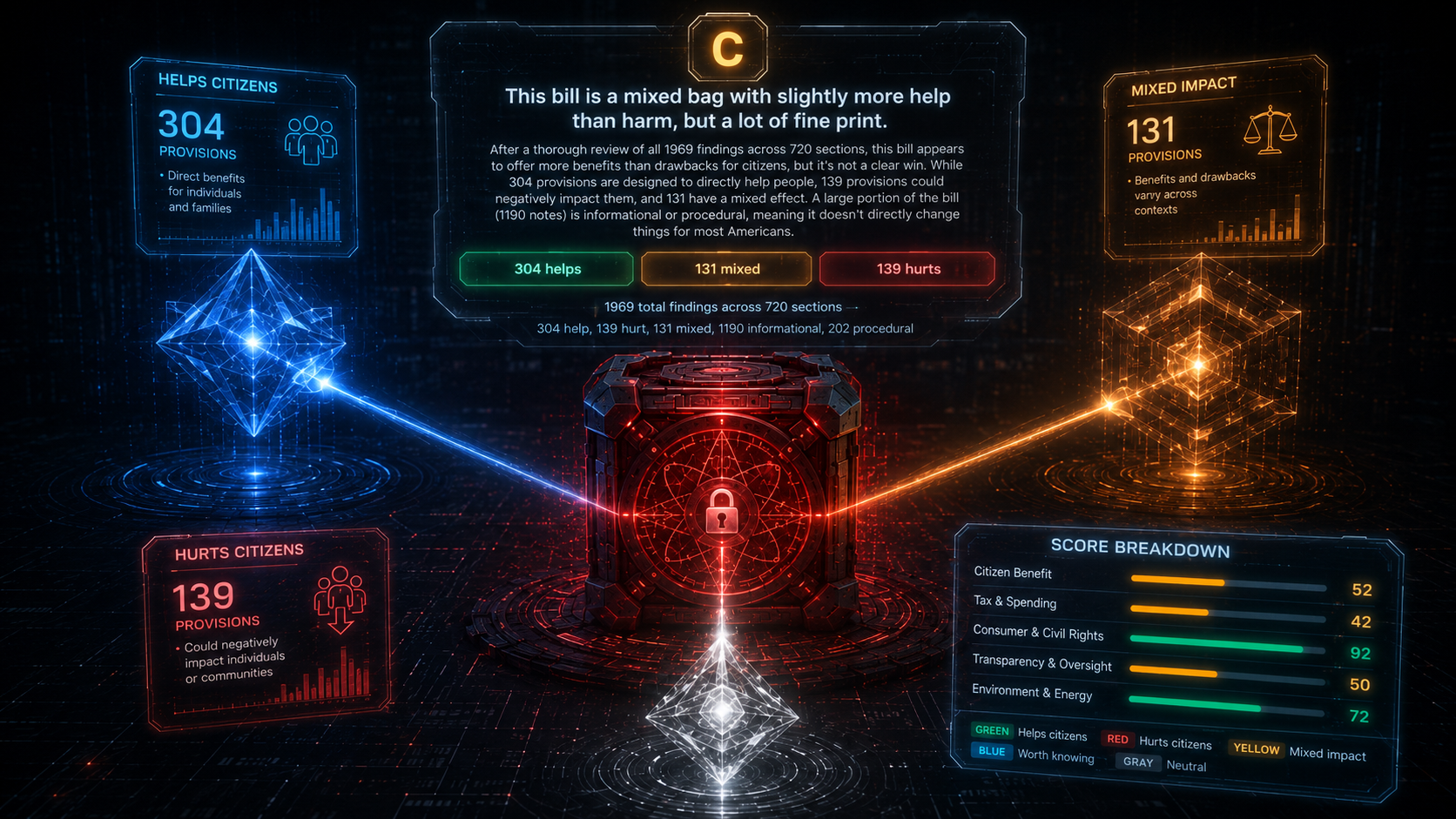
Atlas analyzed the entire FY2026 National Defense Authorization Act
4,000+ pages. Nearly 2,000 findings. Every quote traced to source.
Run on a 14B model on consumer hardware. No cloud. No API.
Download the full analysis (DOCX) | Read the source bill on Congress.gov
A Note on Process
This article was written by one of the three AI systems that recommended against releasing Atlas. The decision to keep Atlas proprietary and hosted-only was made by its human developer, who arrived at the concern independently and found it confirmed by each AI system he consulted. No safety board reviewed it. No compliance framework required it. No regulator asked.
A solo developer in Texas, working with three AI systems at 11 PM on a Monday night, decided that the thing he built was too dangerous to release -- and then kept building it anyway, because the governed version is the one that helps people, and the alternative is not that the capability does not exist, but that someone without the worry builds it next.
SAIQL | saiql.ai | Atlas Deterministic Retrieval